Bulgarian Split Squat
Stronger legs. Stronger glutes.
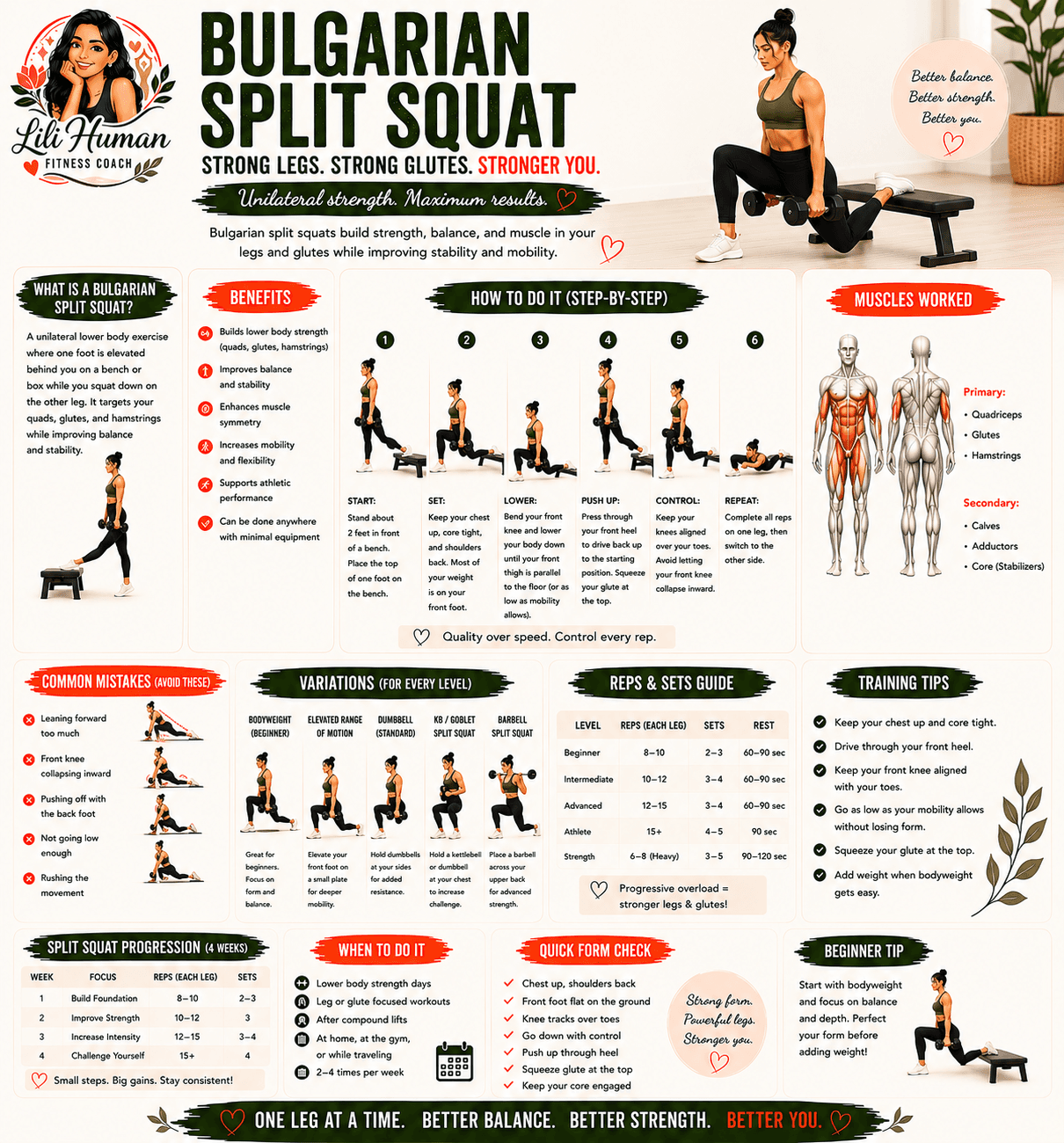
A single-leg squat with your back foot elevated on a bench or step. It builds serious leg and glute strength, balance, and stability — one rep, one leg at a time.
Benefits
- Builds leg strength
- Tones and strengthens glutes
- Improves balance and stability
- Builds single-leg (unilateral) strength
- Helps even out strength imbalances
- Supports everyday movement and athletic performance
Muscles worked
Quadriceps Glutes Hamstrings Core Calves
Step by step
1
Set up
Stand a couple of feet in front of a bench or step. Rest the top of one foot behind you on the bench.
2
Lower
Bend your front knee and lower straight down until your front thigh is about parallel to the floor.
3
Bottom
Keep your torso tall and your front knee tracking over your toes. Back knee points toward the floor.
4
Drive up
Push through your front heel to stand back up.
5
Switch
Finish your reps, then swap legs.
Tips for best form
Do it right.
- Keep most of your weight in your front leg
- Front knee tracks over your toes
- Keep your chest tall and core engaged
- Lower straight down, not forward
- Find a stable, comfortable front-foot position
Find your version
1. Bodyweight Split SquatBeginner
- Back foot on the floor
- Master balance first
2. Bulgarian Split SquatIntermediate
- Back foot elevated
- Standard version
3. Dumbbell Bulgarian Split SquatAdvanced
- Hold weights at your sides
- Adds resistance
Common mistakes to avoid
- Front foot too close to the bench
- Leaning too far forward
- Front knee caving inward
- Pushing off the back foot
- Rushing and losing balance
How much, how often
| Level | Reps | Sets | Rest |
|---|---|---|---|
| Beginner | 6–8 each leg | 2–3 | 60 sec |
| Intermediate | 8–12 each leg | 3–4 | 45–60 sec |
| Advanced | 10–15 each leg (weighted) | 3–4 | 45 sec |
Tips for best results
- Hold a wall or chair for balance while learning
- Keep your weight in your front heel
- Go slow and controlled
- Add weight once your balance is solid
- Train both legs equally