Single-Leg Balance
Better balance. Stronger stability.
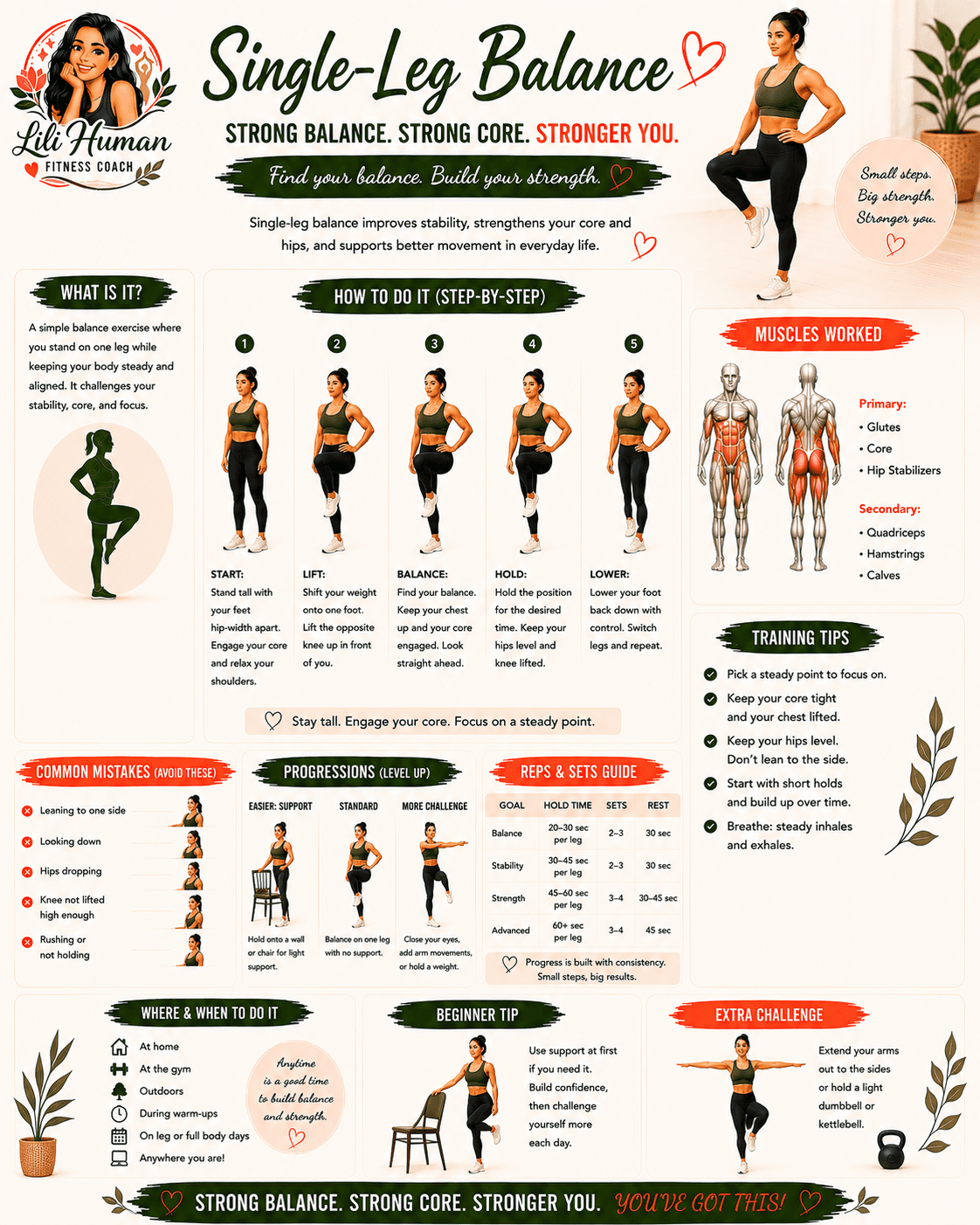
A simple but powerful move: stand on one leg and hold. It builds balance, coordination, and lower-body control that carries into everyday movement and protects against falls and ankle rolls.
Benefits
- Improves balance and coordination
- Builds lower-body stability
- Supports better posture
- Boosts coordination and body control
- Strengthens ankles and feet
- No equipment needed
Muscles worked
Ankles & Stabilizers Glutes Core Legs
Step by step
1
Start
Stand tall with feet hip-width apart, core gently engaged, near a wall or chair if you need support.
2
Lift
Shift your weight onto one leg and lift the other foot off the floor, knee bent.
3
Hold
Balance and hold, keeping your standing leg strong and your eyes on a fixed point.
4
Switch
Lower with control and repeat on the other leg.
Tips for best form
Do it right.
- Fix your gaze on a point ahead
- Keep a soft bend in your standing knee
- Engage your core and glutes
- Keep your hips level
- Use a wall or chair for support if needed
Find your version
1. Supported BalanceBeginner
- Fingertips on a wall
- Build confidence
2. Free Single-Leg BalanceIntermediate
- No support
- Standard version
3. Eyes-Closed BalanceAdvanced
- Close your eyes
- Much harder
Common mistakes to avoid
- Locking the standing knee
- Looking down at your feet
- Hips dropping to one side
- Holding your breath
How much, how often
| Level | Hold | Sets | Rest |
|---|---|---|---|
| Beginner | 15–20 sec each leg | 2–3 | As needed |
| Intermediate | 30–45 sec each leg | 2–3 | As needed |
| Advanced | 60 sec each leg (eyes closed) | 2–3 | As needed |
Tips for best results
- Fix your eyes on one spot to steady yourself
- Start near a wall and progress to no support
- Keep your standing knee soft, not locked
- Balance both legs equally
- Add small movements to make it harder