Plank
Strong core. Stronger you.
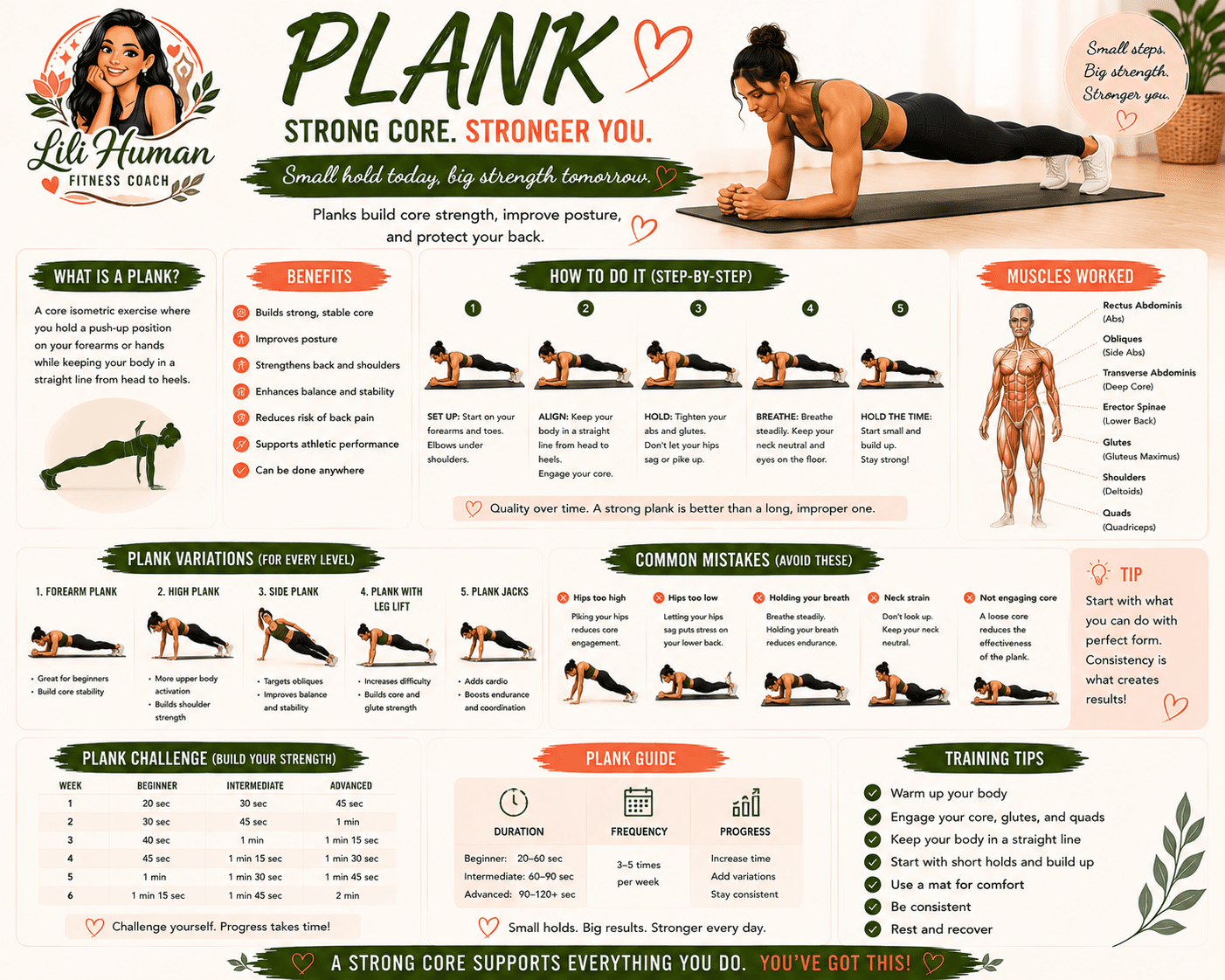
Planks build core strength, improve posture, and protect your back. A core isometric exercise where you hold a push-up position on your forearms or hands while keeping your body in a straight line from head to heels.
Benefits
- Builds strong, stable core
- Improves posture
- Strengthens back and shoulders
- Enhances balance and stability
- Reduces risk of back pain
- Supports athletic performance
- Can be done anywhere
Muscles worked
Rectus Abdominis (Abs) Obliques (Side Abs) Transverse Abdominis (Deep Core) Erector Spinae (Lower Back) Glutes Shoulders (Deltoids) Quads
Step by step
1
Set up
Start on your forearms and toes. Elbows under shoulders.
2
Align
Keep your body in a straight line from head to heels. Engage your core.
3
Hold
Tighten your abs and glutes. Don't let your hips sag or pike up.
4
Breathe
Breathe steadily. Keep your neck neutral and eyes on the floor.
5
Hold the time
Start small and build up. Stay strong!
Find your version
1. Forearm PlankBeginner
- Great for beginners
- Build core stability
2. High Plank
- More upper body activation
- Builds shoulder strength
3. Side Plank
- Targets obliques
- Improves balance and stability
4. Plank with Leg Lift
- Increases difficulty
- Builds core and glute strength
5. Plank Jacks
- Adds cardio
- Boosts endurance and coordination
Common mistakes to avoid
- Hips too high (piking reduces core engagement)
- Hips too low (sagging stresses your lower back)
- Holding your breath
- Neck strain — keep your neck neutral
- Not engaging your core
How much, how often
| Level | Duration | Frequency |
|---|---|---|
| Beginner | 20–60 sec | 3–5x per week |
| Intermediate | 60–90 sec | 3–5x per week |
| Advanced | 90–120+ sec | 3–5x per week |
Quality over time. A strong plank is better than a long, improper one.
Tips for best results
- Warm up your body
- Engage your core, glutes, and quads
- Keep your body in a straight line
- Start with short holds and build up
- Use a mat for comfort
- Be consistent
- Rest and recover