Dumbbell Row
Stronger back. Stronger arms.
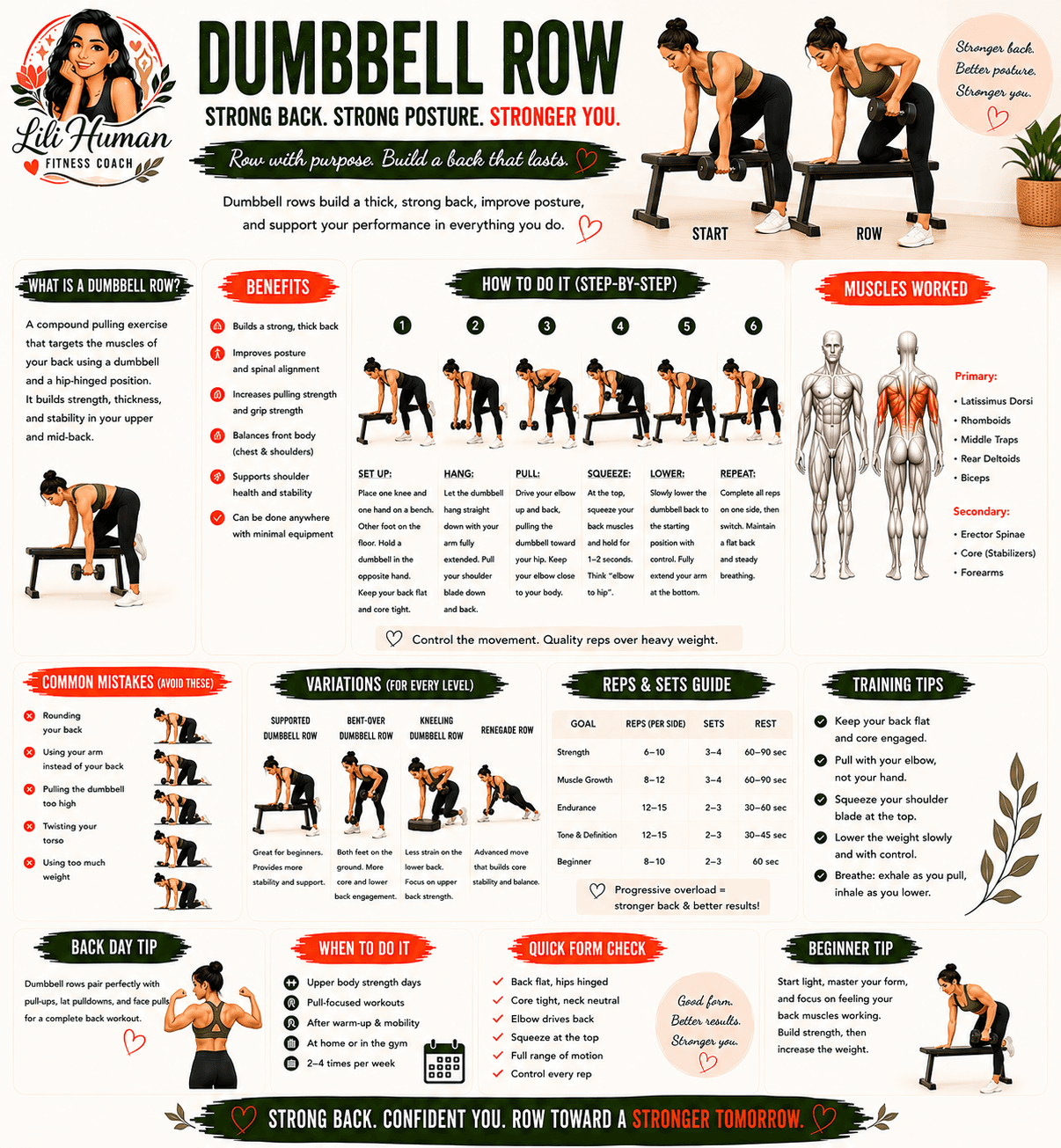
A pulling exercise that builds a strong back and arms while improving posture. Supported on a bench, it’s one of the best moves for balancing out all the pushing and sitting we do.
Benefits
- Builds back strength
- Tones and strengthens your arms
- Improves posture
- Boosts upper-body stability
- Balances out pushing exercises
- Works with a single dumbbell
Muscles worked
Back (Lats) Rhomboids & Mid-Back Biceps Rear Delts Core
Step by step
1
Set up
Place one hand and knee on a bench, other foot on the floor. Hold a dumbbell in your free hand, arm extended.
2
Row
Pull the dumbbell up toward your hip, driving your elbow back and squeezing your shoulder blade.
3
Top
Squeeze at the top with your elbow close to your body. Keep your back flat.
4
Lower
Lower the dumbbell with control until your arm is fully extended.
5
Switch
Finish your reps, then switch sides.
Tips for best form
Do it right.
- Keep your back flat, not rounded
- Pull your elbow toward your hip, not out wide
- Squeeze your shoulder blade at the top
- Keep your core engaged and hips square
- Lower with control — don’t drop the weight
Find your version
1. Bench-Supported RowBeginner
- Extra support
- Great for form
2. Single-Arm Dumbbell RowIntermediate
- One arm at a time
- Standard version
3. Two-Arm Bent-Over RowAdvanced
- Both arms, hinged over
- More back & core
Common mistakes to avoid
- Rounding your back
- Yanking the weight with momentum
- Flaring your elbow out
- Rotating your torso
- Not squeezing at the top
How much, how often
| Level | Reps | Sets | Rest |
|---|---|---|---|
| Beginner | 8–10 each arm | 2–3 | 45–60 sec |
| Intermediate | 10–12 each arm | 3–4 | 45 sec |
| Advanced | 12–15 each arm | 4 | 30–45 sec |
Tips for best results
- Lead with your elbow, not your hand
- Keep your back flat and core tight
- Squeeze your shoulder blade at the top
- Control the lowering phase
- Train both sides equally