Family life
The Wind on My Side of the Car
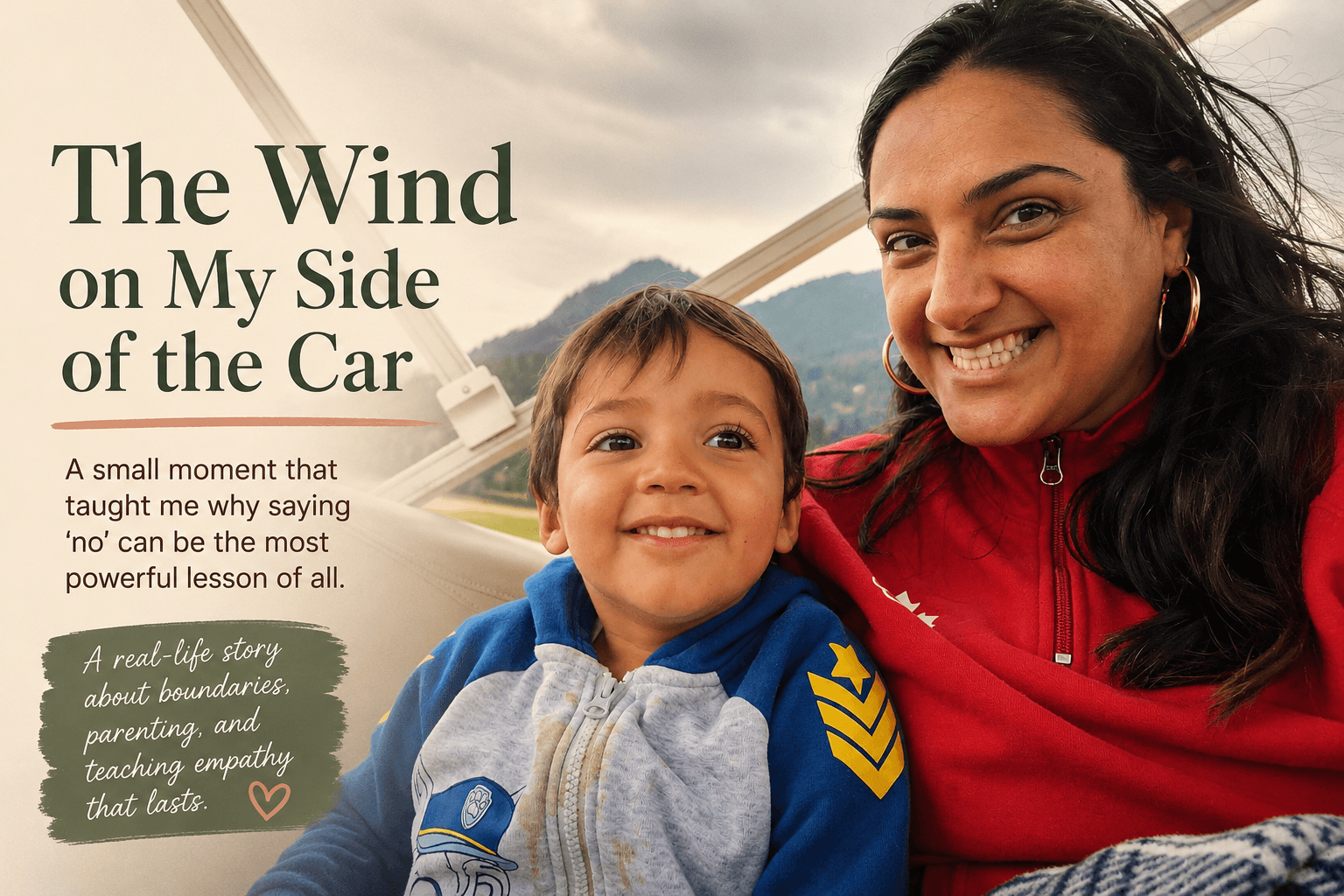
It was one of those afternoons when the heat sits on everything like a hand. I had both front windows down, the air rushing in warm and loud, and for a few minutes I was almost happy in that small animal way you get when your body finally stops fighting the weather.
Then a voice from the back seat. Nico didn't like the wind. It was in his face, it was too much, he wanted it gone.
So I rolled up his window. Of course I did. That's the reflex, worn smooth by three years of use — a need announced, a need met, the loop closing before I've even thought about it. His window went up. The matter, I assumed, was settled.
He looked at me. Then he pointed past me, to my window, the one still open with the wind I loved pouring through it.
"That one too."
And here is where, for reasons I'm still turning over, I didn't move. I told him I liked the wind on my side. I said I was going to keep my window down. It came out lightly, almost as a discovery — as if I were informing both of us of something at the same time.
He pretended to cry. He's good at it; the lower lip, the wet hitch of breath, the whole performance pitched precisely at the soft part of me it has always reached before. I knew it was theater and I knew it usually worked and I held the line anyway. I gave you what you asked for on your side, I said. But I matter too. You don't always get exactly what you want the moment you want it. Sometimes you compromise. Sometimes you think about what someone else needs.
And my son, two years and nine months old, looked at me with the clear and total conviction of his age and said: "It is all about me. I get what I want when I want it."
I want to be honest about what happened next, because it wasn't what you'd expect. I didn't feel angry. I felt found out.
---
For a few days afterward I tried to make that sentence mean something larger than it did. I let it stand in for every worry I've collected about the kind of adult I might be assembling — the entitled ones, the ones who've never been told no, the generation we keep clucking about. I had nearly convinced myself the car was a courtroom and the verdict was in.
But here is the unglamorous truth, and I'd rather tell it than the dramatic one. Nico is not a tyrant. He is almost three. A child that age genuinely cannot yet hold the idea that my experience of the wind is as real and as weighty to me as his is to him. When he says it's all about him, he isn't confessing a character flaw. He's describing, with perfect accuracy, the only world he can currently see. He was being exactly, precisely his age.
So the sentence wasn't about him at all. It was about me — and what it caught me doing was rolling up my own window without thinking, again, the way I had a hundred times before. The startling thing in that car wasn't what Nico believed. It was what I noticed about myself: that somewhere in these three years of meeting need after need after need, I had quietly stopped counting my own preferences as things that were allowed to matter. The wind I loved was the first thing in a long time I'd refused to give away.
---
There's a story a lot of us tell ourselves, the one where good mothering means disappearing. Where the measure of your love is how completely you can subtract yourself from the equation. I believed it without ever deciding to. I just woke up one day on the far side of the subtraction, surprised to find so little of me left in the frame.
But I'm starting to think I had it backwards. A child learns that other people are real by living with a parent who is one — someone with edges, with a window she keeps down, with the occasional unbothered "no, this one's mine." I used to imagine my own needs were the thing I had to set aside in order to raise him well. It turns out they might be the curriculum.
He won't understand it yet. He's almost three; the wind is just the wind. But the next time it isn't a window — the next time it's a friend's feelings, or a sibling's turn, or a stranger on a playground who also, it happens, exists — some part of him will have already met a person who held her ground gently and explained why. That person was his mother. That afternoon was the first lesson, and I almost missed it because I was busy rolling up my window.
I kept it down the whole way home. The heat, the noise, the warm rush of it on the side of my face. It was the smallest thing. It felt enormous.
---
These are the moments I'd lose entirely if I didn't write them down. If you'd like to catch your own — the small, enormous ones — I made a free memory-keeping starter: a few prompts, a five-minute weekly ritual, nothing precious about it.